Guide
Viking Range Igniter Problems and What Actually Fixes Them
A clicking burner, a glowing oven igniter and a cold oven are three different faults. How Viking ignition really works, what fails, and which checks are safe to do yourself.
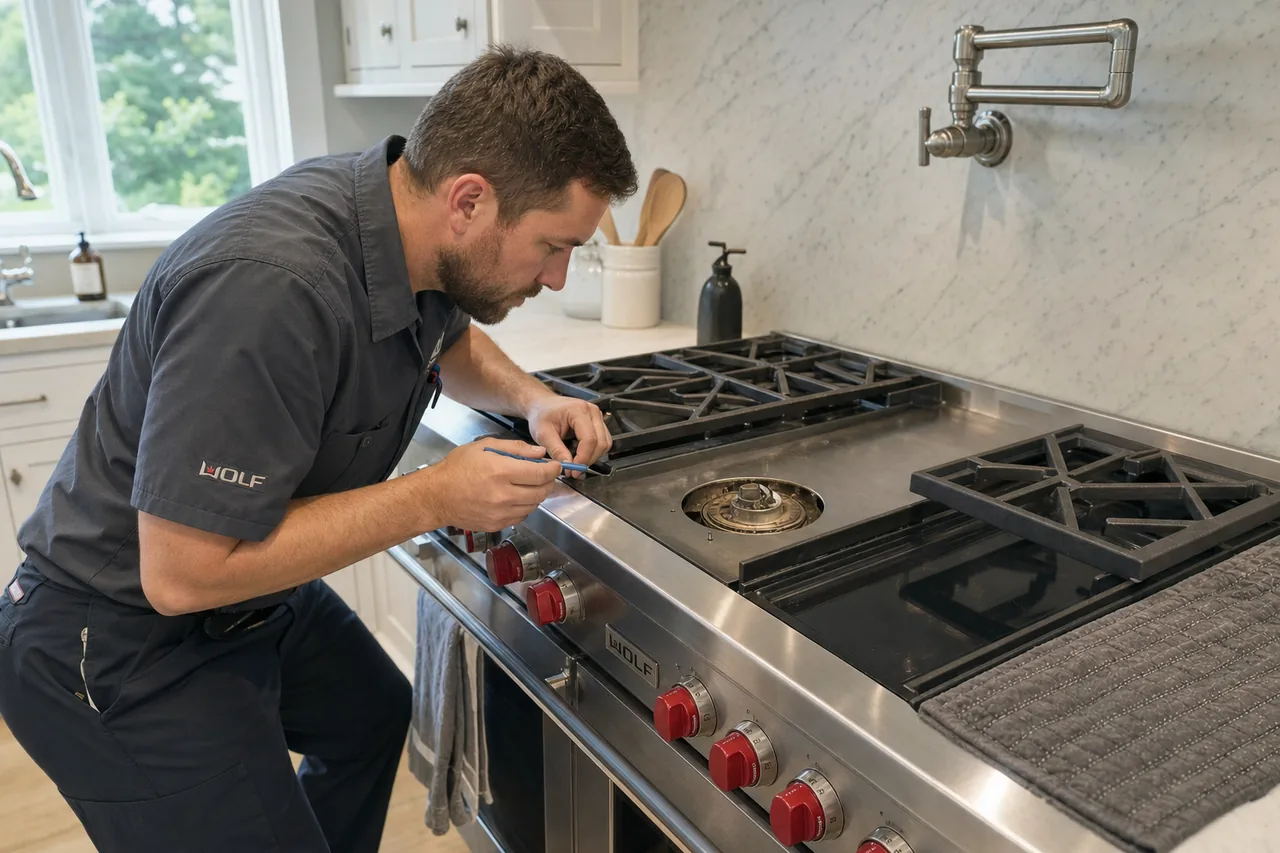
Ignition is the single most common reason a Viking range gets a service call, and it is also the fault most often repaired twice — once wrongly, then once properly. The reason is that three very different problems all present as “it will not light”, and the part that gets replaced is usually the one that is easiest to see rather than the one that has failed.
This guide separates them. Surface burners and oven burners use different ignition systems and fail for different reasons, so we will take them in turn.
Surface burners: the clicking that will not stop
On a Viking sealed-burner cooktop, one spark module serves the whole top. Turn any knob to the light position and the module fires every electrode at once. That single design fact explains the symptom that worries people most: you turn on the front left burner and hear clicking from all four positions.
That is not a failed cooktop. It is the module doing exactly what it is built to do, and it usually means one of the following:
A burner cap seated slightly off. The cap has to sit flat on the base for the flame to carry around the ports. Lift it, check the underside is clean, and set it back squarely. This is the most common cause and it costs nothing.
A blocked burner port. Boil-overs leave sugar and starch in the ports. The spark is fine, the gas simply is not arriving where the spark is. A straightened paperclip clears a port; a pin or a drill bit will enlarge it and ruin the flame pattern permanently, so use something that cannot cut.
A cracked electrode ceramic. This is the one an owner cannot fix and the one that most often gets misdiagnosed as a dead module. The electrode is a metal tip in a white ceramic sleeve. A hairline crack in that ceramic lets the spark leak to the burner body instead of jumping the gap to the gas. You will often still see and hear a spark somewhere, just not where it needs to be. Replacing one electrode is a fraction of the cost of a module.
Moisture. On the Sands Point peninsula this matters more than it does inland. After a run of humid days, or a spill that ran down into the burner well, a burner can spark without lighting until it dries out. If the burner recovers on its own after a day, moisture was the cause. If it never recovers, the humidity simply revealed an electrode that was already cracked.
Only after all four have been ruled out is the spark module a sensible suspect — and a genuinely failed module usually produces no spark at all rather than clicking.
The oven: why a glowing igniter still means no heat
This is the fault that catches almost everyone, including some technicians.
On a standing gas oven, the igniter is not merely a lighter. It sits in series with the gas safety valve and acts as the current-limiting element in that circuit. The valve only opens when enough current flows through the igniter. As a hot-surface igniter ages, its resistance rises. It still heats. It still glows bright orange. But it no longer pulls enough current to open the valve, so no gas ever arrives.
What the owner sees is an igniter glowing away in a cold oven, and the natural conclusion is that the gas valve has failed. The valve is usually fine.
The correct test is a current measurement on the igniter circuit while it is calling for heat — not a look at the glow. A weak igniter is an inexpensive part. A gas valve replaced on a wrong diagnosis is not, and the oven will still not heat afterwards.
There is a rough field rule that goes with this: time the igniter. A healthy hot-surface igniter on a Viking oven will normally have the burner lit within about a minute of starting to glow. If it glows for well over a minute and nothing happens, it is weak, even though it looks perfectly healthy.
The third fault: it lights, but badly
A less dramatic version of the same problem is an oven that does light, but only after a long delay, sometimes with a soft thump as accumulated gas catches. That is a warning, not a quirk. It means the igniter is on the edge of the current threshold: some cycles it opens the valve promptly, some cycles it takes long enough for gas to pool first.
That delayed ignition is worth fixing before it becomes a no-heat, both for the obvious safety reason and because it usually also means the oven is not holding its temperature properly between cycles.
What is safe for an owner to do
There is a clear line here, and on a professional range it is worth respecting.
Safe: lifting and reseating burner caps, cleaning ports with something soft, wiping spills out of the burner wells once the range is cold, checking that the range is actually getting gas by testing another burner, and cleaning the cooktop properly so a spill does not migrate into the next burner.
Not safe, and not an owner job: anything behind the control panel, anything involving the gas valve or the manifold, replacing electrodes or igniters, and anything that involves disconnecting the range from the gas supply. Ignition components sit in the gas path, and the safety valve is the component that stops an unlit burner filling the room.
Why we see more of this near the water
Two of the failure modes above are accelerated on the North Shore. Salt-laden humid air keeps burner wells and electrode ceramics damp for longer, and it corrodes the plated steel of burner caps, grate feet and the screws holding the ignition hardware. A cracked ceramic that would have lasted another two years inland will start misfiring here in the first humid spell.
The maintenance answer is not complicated: keep the burner wells dry and clean, and wipe salt film off the cooktop with fresh water rather than letting it sit. That will not stop an igniter aging, but it will stop the two coastal failure modes arriving early.
When to call
Call if the oven will not light, if it lights with a delay or a thump, if a burner clicks without lighting after the cap and ports have been checked, or if you can smell gas at any point — in that last case shut the supply off at the range first.
Range and oven repairs typically run $250–$900 depending on the part, and the $95 diagnostic is credited toward the repair. Gold Coast Appliance Repair is an independent specialist — not affiliated with Viking — and every repair is backed by a 1-Year Parts & Labor Warranty. Call (914) 483-3420 for same-day service in Sands Point and across Nassau County.