Guide
Moving a Built-In Refrigerator Without Destroying It
Built-in refrigeration does not travel like a freestanding fridge. Vacuum panels, oil return, door panels and cabinet openings — what to get right before the truck arrives.
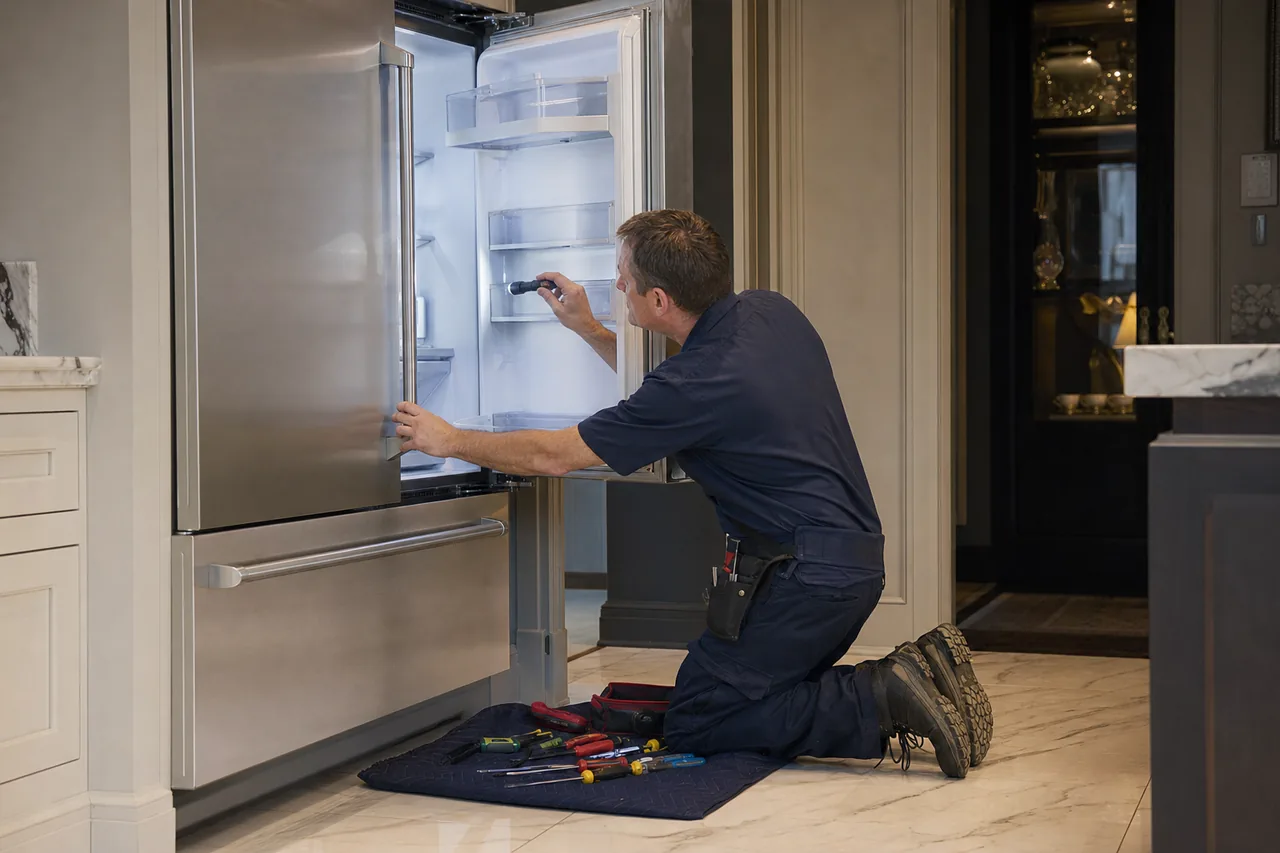
Most of the damage we are called to after a move happened in the twenty minutes the appliance was on its side, or in the first hour after it was plugged back in. Neither is obvious at the time, which is why this is worth reading before the move rather than after it.
A built-in refrigerator is not a large freestanding one. It is a vacuum-insulated cabinet with a critical refrigerant charge, sized to a joinery opening, usually carrying custom door panels, and on a 48-inch model it can weigh in the region of 600 to 800 pounds before anything is in it. Every one of those facts changes how it has to be handled.
Before anything moves
Empty it, then let it warm up. Not just food — shelves, bins and door racks travel separately and wrapped. Glass shelves in a moving cabinet break, and the replacements are not cheap. Give the unit a day to come up to room temperature so you are not fighting condensation later.
Photograph the installation. The grille, the panel mounting, the hinge position, the levelling legs, the water line route and the electrical connection. On a reinstallation two months later in a different house, these photographs save hours.
Remove the door panels properly. Custom panels are fitted to that door with specific hardware, and panel weight is part of what the hinge is set for. Take them off, label them left and right, and transport them flat and separated. Do not use them as handholds.
Shut off and drain the water line if the unit has an ice maker or dispenser. Disconnect at the valve, not by pulling the tubing, and let the line drain before it is coiled.
Getting it out of the opening
This is where floors get damaged and cabinet faces get broken.
Built-ins are usually secured to the surrounding cabinetry at the top or the sides. Find and remove those fixings before applying any force — a unit that will not come forward is almost never stuck, it is almost always still screwed in.
Lower the levelling legs or wheels so the weight comes off the cabinet, protect the floor with hardboard rather than trusting a blanket, and use enough people. On a stone floor a dropped corner damages the floor, not the appliance.
The one rule that matters most: keep it upright
If you take away nothing else, take this.
Laying a refrigerator on its side lets compressor oil migrate out of the compressor and into the refrigerant lines. When it is stood up and powered on immediately, the compressor starts with insufficient oil and the oil that left is now sitting where it restricts flow. The damage is cumulative and it is not covered by anything.
Transport upright. If circumstances make that genuinely impossible — a stairwell that cannot be negotiated any other way — then the unit must stand upright for a full 24 hours before power is applied, and longer is better. There is no shortcut here and no way to tell by looking whether the oil has returned.
The vacuum panels
Sub-Zero and comparable built-ins use vacuum-insulated panels for their insulation value. A vacuum panel that is punctured or crushed loses its vacuum permanently, and there is no repair. The cabinet will still run, but it will run harder, cost more and struggle in warm weather — and the fault is close to impossible to prove later.
In practice that means: no straps over the cabinet faces without protection, no levering against the side panels to get round a corner, and nothing dropped against the cabinet in the truck. Treat the shell as if it were glass, because functionally it is.
Reinstalling
The opening has to be right. Built-ins are specified with particular clearances at the top and sides for airflow. If the new opening is tight, or the joinery in the new kitchen is deeper, the unit will run continuously and never quite reach temperature — and it will look like a refrigeration fault. We see this repeatedly in renovated Flower Hill and Sands Point kitchens and it is a joinery problem, not an appliance one.
Level it before you load it. A built-in that is not level does not self-close, and a door that does not seal will ice the evaporator within weeks. Level front to back and side to side, then check the door swings shut from half open.
Reconnect the water line to a proper shut-off, and run several cycles of ice to waste before anyone drinks it. The first ice after a move is always discarded.
Then wait. Stand it upright for the recommended period, power it up empty, and give it a full day to pull down before loading it. Judging temperature after two hours tells you nothing.
What to check a week later
Put a thermometer in each compartment and read it. Fresh food should sit around 37–38°F and the freezer at 0°F. Listen for a compressor that never cycles off. Look behind the lower grille for a condenser that picked up dust in transit — moves are dirty, and a coil that was clean before is often not afterwards.
If the unit is running constantly, drifting warm, or noisier than it was, have it looked at before the pattern sets in. A post-move fault caught in the first fortnight is usually airflow, levelling or a loose connection. The same fault left for six months is often a compressor.
A note on insurance and liability
Appliance damage in a move is frequently disputed because nothing is visible. Photographs before the move, a note of how the unit was transported, and a temperature reading in the first week are what turn a dispute into a claim. It costs nothing to have them.
If a built-in has been moved and is not holding temperature, get it measured before it is loaded again. The $95 diagnostic is credited toward the repair. Gold Coast Appliance Repair is an independent specialist covering Sands Point and Nassau County, not affiliated with any manufacturer, with a 1-Year Parts & Labor Warranty on completed work. Call (914) 483-3420.